Movies

New Releases • A-D • E-H • I-P • Q-Z • Articles • Festivals • Interviews • Dark Knight • Indiana Jones • John Wick • MCU
How to Make a Killing, starring
Glen Powell and directed by John Patton Ford
Trailer: A24
How to Make a Killing
Directed by John Patton Ford
Rated R
Sentenced 20 February 2026
#HowToMakeAKilling
How to Make a Killing isn’t worth it.
How to Marry a Billionaire
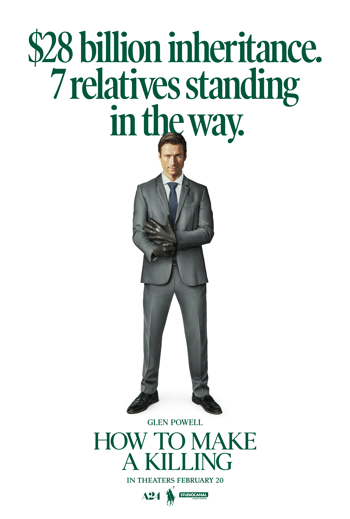
It seems as though this movie wants to be a biting satire. Problem is, it’s toothless. It wants to be a smart movie, too. But that would require the audience to dumb down.
Writer/director John Patton Ford (of no apparent relation to either famed movie director John Ford or military genius George Patton) has based his story on Kind Hearts and Coronets, a 1949 comedy starring Alec Guinness (playing eight different heirs, both male and female) , which was in turn based on a 1907 novel by Roy Horniman entitled Israel Rank: The Autobiography of a Criminal. So, this story has been floating around for more than a century.
Unfortunately for Ford (the writer/director behind Emily the Criminal, starring Aubrey Plaza), he fails to update the story sufficiently for modern times. The original early 1900s setting in Kind Hearts and Coronets made murder investigations far more challenging than today and Scotland Yard’s appearance was relegated to the bitter end. However, what was glossed over then cannot be now. Topping it off, that original movie, released 77 years ago, sports a superior, multi-layered ending that leaves the mind reeling as to what happens next.
Ford’s rendition is overly simple and deeply reliant on a twist ending that either makes it or breaks it depending on how you perceive it. It’s a tricky thing, then, to honor the sanctity of the spoiler while also suggesting the best reading of the ending is that perhaps the criminal protagonist-as-such, Becket Redfellow (Glen Powell), is ultimately sentenced to a fate worse than death.
That’s one interpretation. But, as the ending plays out, the more entertaining aspect comes from rattling off all the possible endings that would’ve been better and could’ve landed with far greater impact.
That said, the movie starts with Becket on death row, with only four hours left before his execution. At his request, a priest (Adrian Lukis) comes to visit him. Becket makes a full confession of all his crimes (which would be inadmissible in court, should the question arise), while also asserting a sense of calm and assurance that he won’t be executed. He insists the story behind his landing on death row is far more impressive than the stories told in the trial that sent him there.
You see, Becket is the son of Mary (Nell Williams), a Redfellow empire heiress who fell in love at the tender age of 18 and got pregnant. That led to her being banished from the Redfellow mansion. In legal theory, Becket would still be eligible to inherit the vast Redfellow fortune (billions in cash, mansions, boat, planes, islands and who knows what else) .
Tragically, Becket’s father suffered a pulmonary embolism and died at Becket’s birth. His mother died when he was only seven. But her dying wish was for him to promise her he would never quit until he was able to live the “right kind of life.”
Never give up.
Never settle.
Problem is, he’s eighth in line to the Redfellow fortune. The seven ahead of him need to kick the bucket before he can get his hands on the empire.
How to Succeed in Business Without Really Trying
So it is Becket goes on a murder spree.
Of course, his goal is to make each death look like some sort of unfortunate accident. The first one is a “simple” kill, annihilating a drunken relative by way of the ol’ boating accident trick involving an ill-placed anchor.
A remote setting, no witnesses.
Great.
The focus isn’t so much on the murders. They happen rapidly (the movie’s only around 105 minutes). Poisoning is a common, easy-to-execute modus operandi. Chemical reactions in a darkroom is a clever way to close the shutter on the sole artist in the family, a photographer named Noah (Zach Woods). Another standout (but not outstanding) Redfellow is Steven (Topher Grace), a silly character who’s a rockin’ pastor of a youthful congregation and a global crusader opening churches throughout Asia while also keeping company with despicable characters such as El Chapo.
Nothing about the Steven situation is remotely credible as played out here.
One hiccup: Becket builds a solid, trusting and caring relationship with an uncle, Warren (Bill Camp), who regrets not helping the younger Becket through his childhood. But Warren suffers a heart attack.
Some of the killings are clever and hard to trace. But the rapidity of the killings within a single wealthy family should kick off all sorts of investigations. And it shouldn’t be hard to place Becket at each scene – or at least most of them – to yield some solid evidence.
And yet the FBI is repeatedly stumped. They’re practically Keystone Kops. They even fall in line with Becket’s one attempt at covering his own tracks by having an unwitting soul grab a hotdog from a street vendor, miraculously being caught on a surveillance camera wearing some of Becket’s garb so Becket can seamlessly offer an alibi for one of his episodes. It’s a superficial and silly nod to modern times.
And when it comes down to the final confrontation with his own grandfather, Whitelaw Redfellow (Ed Harris), in the Redfellow mansion, it all goes sideways.
No way.
There’s a butler.
Surely there are security cameras everywhere.
This bizarre murder involving a bow and arrow could not possibly be excused as an accident and Becket’s a little too cocky with his self-defense argument. None of that matters. He’s never even investigated.
That would be hard to argue away, so Ford simply tiptoes past it.
How to Make It in America
There are fleeting moments of wit that suggest How to Make a Killing could’ve been so much more.
It starts early, in the first scenes on death row. For dessert, Becket’s served vanilla instead of chocolate. Becket mumbles, “Kill me now.”
Cute.
At one point, Noah autographs a photo for Becket by signing it “White Basquiat.” Okay. Interesting pop culture reference.
Another character jokes about how starved she is: “I could literally eat Sbarro.” A stupid comment about an Italian fast-food chain, but indicative of a social superiority complex.
Counter those quips with some earnest moments about the work world and there could’ve been more meat to all this.
To wit, Uncle Warren, while on his deathbed, questions his own financial success and its underlying cost to his own health and well-being. The work, the long hours, the fractured relationships. And it’s only Becket who visits him in the hospital.
Loving relationships are the only things that truly pay, Warren says.
Then there’s Whitelaw, who speaks in double entendres about corporate life. Make a killing in the market. Eliminating the competition. Violent terminology tears through his professional vernacular.
And Whitelaw lands this zinger: We all have voices inside us telling us what’s right and wrong. It leads to an internal dissonance. But the best at the game work at silencing those voices so even a gentle wind can drown it out. It’s a relatively powerful observation in the thick of the movie’s darkest moment.
It’s effective, especially as it’s delivered by Ed Harris.
If only How to Make a Killing had more of that weight to it.
How to Lose a Guy in 10 Days
Of course, what ol’ Whitelaw has to say isn’t the greatest advice. It certainly doesn’t absolve the perpetrator of those horrendous, destructive actions the voices rail against.
But wait. There’s more.
Then there’s Julia. Whoa.
It’s one thing to be an unlikable character. It’s next level to be unlikable as an unlikable character. Margaret Qualley is woefully miscast as Julia, a semi-unhinged sex pot who met Becket as a 7-year-old and never, ever forgot his statement about how one day he’d inherit billions.
A chance encounter years later, while Becket’s finding his footing in the work-a-day world, leads to a tease of genuine romance, but it’s merely a tease. She’s married now. So miserably married to a lying lug.
And Becket goes on to find seemingly true love with Ruth (Jessica Henwick), Noah’s one-time girlfriend.
Julia becomes a recurring fly in the ointment and she becomes a significant factor in that twist ending. She’s a strangely menacing old friend who is more adversary than would-be lover.
On the surface, it’s an aggravating ending.
Allowing time for more thought, it becomes merely a disappointing ending. In retrospect, thematically and ideologically, it’s a pretty sound finale.
But, just as Becket misses out on his execution, so to does Ford miss out on executing the ending in a way that hits its mark.
• Originally published at MovieHabit.com.
Contact 
Write Matt
Visit the Speakers Corner
Subscribe to Mattopia Times
Support 
Help Matt live like a rock star. Support MATTAID.
It's a crazy world and it's only getting crazier. Support human rights.
Search 
The Mattsonian Archives house more than 1,800 pages and 1.6 million words. Start digging.