Movies

New Releases • A-D • E-H • I-P • Q-Z • Articles • Festivals • Interviews • Dark Knight • Indiana Jones • John Wick • MCU
Go behind the scenes of Michael
with star Jaafar Jackson and director Antoine Fuqua
Featurette: Lionsgate / Universal Pictures
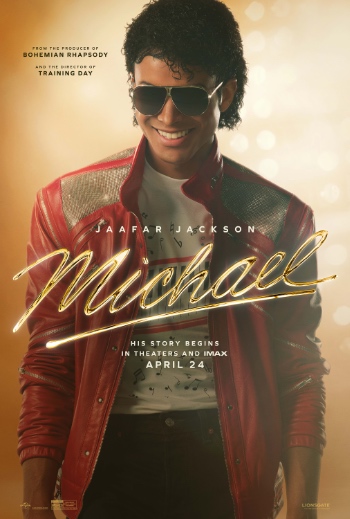
Michael (2026)
Directed by Antoine Fuqua
Rated PG-13
Thrilled 24 April 2026
#MichaelMovie
Set aside the skepticism and the controversies. Michael feels really good.
Cancel Culture Club
Who’s to say what life would be like for Michael Jackson if he were still alive in 2026. This is, after all, the not-so-enlightened age of cancel culture and vitriolic polarization across political and cultural divides.
It’s a world in which J.K. Rowling is widely criticized for taking her own personal stand on hot topics of gender and identity. Contrarian views are dismissed outright. It’s a post-Jeffrey Epstein world mired in an insatiable search for justice based on scattered references.
Now, approaching 17 years since Michael died, this movie sidesteps the moonwalker’s missteps. This isn’t a movie about all the allegations of pedophilia and lawsuits and conspiracies surrounding Michael’s off-stage behaviors.
Granted, the Jackson estate was – by all accounts – deeply involved in this production. But it’s a production that’s been transformed during the creative process. John Logan – the screenwriter behind many phenomenal movies, including Skyfall, Gladiator and The Aviator – originally intended to include the scandalous side. But behind-the-scenes wrangling started to steer away from that thread as threats of lawsuits came to the fore. Lawsuits, that is, from alleged victims.
It’s all so unfortunate. It’s distasteful – on different levels – to refer to Michael as a “whitewashing” of what was.
Take a deep breath and put Michael in perspective.
It Stings
Michael focuses on the era of 1966-1988, starting with Michael as a 10-year-old member of the Jackson Five. That’s a whole lot of ground to cover in a fast-paced, virtually effortless two hours. From there, it’s a meteoric rise not just for Michael, but the whole Jackson family, a rise driven by an abusive father but even more so by a relentless creative mind seeking to use his platform of fame to make a difference.
At times Michael feels watered down even going beyond the scandal-free angle. Indeed, there are times when Michael plays out a bit like a Hallmark movie. But those moments are rare.
Nonetheless, it’s a lazy criticism to say Michael is a botched opportunity because it doesn’t dig deep (or even mention) the accusations of pedophilia that started to chip away at his reputation. The movie does introduce other elements. There are the pain killers, brought on by the horrific injuries Michael sustained while filming a Pepsi commercial in 1984. There’s a new appreciation for how bad it was; second-degree burns with significant nerve damage. It was dangerous and could’ve easily turned into something wholly disastrous.
That incident is its own significant turning point for Michael. At least in this movie’s narrative, he says, “I don’t want to take medication.” “But you’ll be in a lot of pain,” doctors advise.
Those painkillers. The addiction. Certainly, they’re significant elements in his untimely death 25 years later.
But even before that incident, Michael the movie shows Michael the up-and-coming superstar as a kid living off the beaten path. His at-home zoo starts early. But there’s a strange element of sadness associated with those animals; he sees them as more reliable and relatable friends than kids his own age. And, yeah, Bubbles, the chimp (the CGI chimp) moves into the house.
Yellow Brick Roads
Given how colorful and larger-than-life Michael’s life was, Michael could’ve used a more fanciful hook, like Dexter Fletcher’s wildly creative Elton John bio-pic, Rocketman. After all, references to Peter Pan and Neverland come early and often.
But there’s still more to this movie that makes it hold its interest. Look past the gloss and check out Joseph Jackson, so stunningly portrayed by Colman Domingo. Tough as nails, he never wants his family to forget he’s the one who moved them out of the steel mills. His ambitions and drive provided the whole family with creature comforts they wouldn’t dare dream of merely a few years prior. But he is relentless and dominating, even as Michael grows up and moves into a position of being able to call his own shots.
And in one of the movie’s most telling scenes, it’s Joseph who – at least in this movie’s version of reality – challenges Michael with this thought: What does he want? To be surrounded by people who always say “yes” to everything? It’s a brilliant bit of foreshadowing of what’s to come: the yes-men, the sycophants, the enablers who shield Michael much to his own detriment.
While this movie is produced by Graham King, who also produced Bohemian Rhapsody (the Oscar-winning movie about Queen) and Jersey Boys (about The Four Seasons), and John Branca (Michael’s real-life manager), there’s a significant connection between Michael and A Complete Unknown, the Bob Dylan bio-pic. It has to do with a creative soul in non-stop, relentless pursuit of a creative release, of liberating expression.
That’s Michael’s real hook. There are scenes here – so simple in concept, so deep in impact – in which Michael jots down ideas on note cards then stares them down on a corkboard. Earlier, during his childhood, a mirror can be seen covered in positive affirmations and mantras. One of those notes is a personal favorite of this writer: “Everything you want is on the other side of fear.”
To the extent these pieces of the Michael Jackson puzzle are legitimate, they help cast an exciting view of the musical genius, the King of Pop.
Take a Beat
Michael – those scandals aside – is a reminder of what the world’s lost. Look beyond the nostalgia for a pre-social media world in which new music is hyped through personal appearances and the excitement of fans gathering outside the local Tower Records.
In these divisive times, Michael’s a reminder of how there was an artist who sought to bring people together, regardless of whether they’re black or white. There are the challenges to overcome. For one, getting a black artist’s videos into the rotation on MTV (when it played music videos).
For that matter, there was Michael’s desire to make short films for his songs. Enter director John Landis and the industry-shaking Thriller video. With all that creative energy – which also covers ABC, Beat It and Billie Jean among others – Michael is a thrill in IMAX. Great sound. Great energy. It’s a great feeling.
There’s simply no argument about Michael’s creative light and public push for some sort of common ground, all amid behind-the-scenes issues like his vitiligo and the need to break away from his father’s rule.
Given this movie ends in 1988, there’s plenty more to be told – not just as those scandals start to pile up – but as Michael adjusts to his own new reality of fame, fortune and creativity.
Man in the Mirror
At the core of this movie is Jaafar Jackson, who is – in reality – Michael Jackson’s nephew and Jermaine Jackson’s son. His performance – his likeness, his dance moves, his voice – is astonishing. At times it’s even borderline eerie as the production used a technique in which Jaafar sang on top of Michael’s voice for some performances.
This is in many respects director Antoine Fuqua’s most complete creative work. Alongside those stunning performances from Jaafar and Colman, there’s Miles Teller as Branca.
Any bio-pic is subject to criticisms of certain realities and facets not being put in play and it’s no different here. They’re not the focus, no matter the factors driving those creative decisions.
This work stands on its own and should be taken on its own.
• Originally published at MovieHabit.com.
Contact 
Write Matt
Visit the Speakers Corner
Subscribe to Mattopia Times
Support 
Help Matt live like a rock star. Support MATTAID.
It's a crazy world and it's only getting crazier. Support human rights.
Search 
The Mattsonian Archives house more than 1,800 pages and 1.6 million words. Start digging.