Movies

New Releases • A-D • E-H • I-P • Q-Z • Articles • Festivals • Interviews • Dark Knight • Indiana Jones • John Wick • MCU
Ramayana: Rise of a Legend, starring Ranbir Kapoor, Sai Pallavi and Yash, directed by Nitesh Tiwari
Trailer: Sony Pictures
Ramayana: Rise of a Legend
(Hindi Version)
Directed by Nitesh Tiwari
Rated PG-13
Born 6 November 2026
#RamayanaMovie
As with the magnificence of Wildwood and The Odyssey, Ramayana: Rise of a Legend deserves to be seen on the biggest screen available.
Poetry in Motion
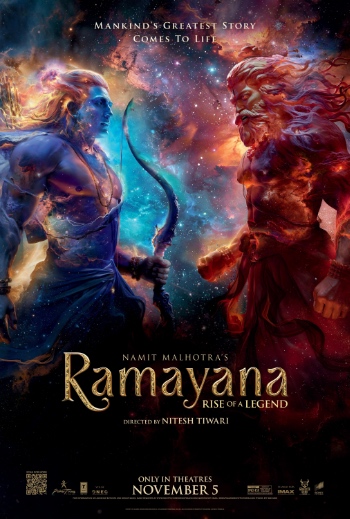
There’s a whole lot going on in the worlds of Ramayana, and that extends from what’s on the screen out to the production behind the cameras. This is a massive, sprawling epic and Rise of a Legend is merely the first of two movies. Maybe it’ll be three, a nice round trilogy. A lot is up in the air right now, but Rise of a Legend is here in time for Diwali 2026 (November 8) and part two has been pushed out an entire year, from Diwali 2027 to Diwali 2028 (October 15). There’s plenty of post-production work to be done, so it’s also an opportunity to make some adjustments based on how audiences respond to this movie.
It gets trickier.
The “original” version is an epic, briskly paced 195 minutes (without an intermission). It’s in Hindi spoken language with English subtitles. But there’s also a “Western” version trimmed to 162 minutes and with some narrative alterations, a factor which further complicated the movie’s production.
Sporting a combined production budget of around $500 million across parts one and two, this is the most expensive production in Indian film history. That alone will raise eyebrows and intensify the scrutiny.
But let’s dial it all back. Way back. Ramayana is based on an epic poem credited to Valmiki, a wise philosopher living around 1200 BC. In comparison, Homer is credited with writing The Odyssey sometime around 700 BC.
That’s part of what makes Ramayana so fascinating. So many of the foundations of modern storytelling (and, for that matter, ancient storytelling) can be found in its verses. The seeds of so many popular classics are right there: Lord of the Rings, Star Wars, Gladiator, Greek mythology, Marvel. It’s easy to hear Joseph Campbell whisper sweet nothings about the hero’s journey deep in the background.
For an example, there is a colorful episode involving a challenge to win the hand of a beautiful princess, Sita (Sai Pallavi). The suitor must string a bow. Sound familiar? A twist here is the bow is Lord Shiva’s and it’s impossible for most people to even lift it.
But there is one man.
Prince Ram (Ranbir Kapoor). He has the strength to lift the bow one-handed. And he also has the strength to unintentionally break the bow while attempting to string it.
Where does he get that incomparable strength? He’s Vishnu, protector of the universe, incarnate.
The Hand of Destiny
As a Westerner looking East, to South Asia, there’s a whole lot to take in and digest while watching Ramayana: Rise of a Legend. Even with its extended runtime, it’s an exhilarating ride with such incredible visuals and so many ideas that play out before fresh eyes. Following classic Bollywood traditions, it even seamlessly breaks into musical moments that make the overall experience pop (credit goes to the unprecedented pairing of Hollywood film legend Hans Zimmer and Bollywood film legend A.R. Rahman in crafting the score).
Ramayana is of such a massive scale, it’s essentially a 3-hour extravaganza of big movie moments. It’s kind of like watching the original Star Wars trilogy (Episodes IV-VI) pared down to half the runtime and showing only their greatest scenes of visual splendor, quotable dialogue and spectacular set pieces of thrilling action and boundless heroics. Those sensations permeate virtually every single frame. From that angle, Ramayana is a total blast.
To these Western ears, the dialogue sounds suitably reverential, particularly given the millennia-spanning source material. It feels right.
It seems natural, but maybe some will find that approach off-putting.
Throughout Rise of a Legend, Ram is presented as an individual of integrity and fidelity. He’s the height of all virtue. And he questions life and the idea of “fate” – his own and those of others. How is it some are made to work in fields while he lives a posh life in a palace? His is a life of humility, no matter his environs. His dream is justice for all.
And yet he is O so powerful. Prince Ram is a multi-talented, ambidextrous hyphenate who can shoot at falling bells, making them ring, while blindfolded and riding a horse. It’s – in a word – spectacular.
There’s a core theme running throughout Ramayana. It circles around the whole notion of “destiny.” What is it? Who determines what it is and for whom? The simplistic idea that “everything happens for a reason” is something this writer has been grappling with for the past two years in particular.
And that’s also where the conclusion of Rise of a Legend hits its strongest punch, grabs onto an emotional turn of events and sets the stage for Part II. Ram makes a declaration, “If this is my life, I do not accept it. From this day forward, I will write my own destiny.”
It’s a fantastic moment that grips this writer’s soul.
Self-determination is quite a thing. It’s a timeless concept that certainly drove Ayn Rand, while Margaret Mitchell, to a limited degree, circled around the mindset with Scarlett’s declaration to never be hungry again.
That emotion is earned through the previous 3 hours of Ram demonstrating patience, perseverance and fulfillment of duty. That moment also sets high expectations for the next chapter.
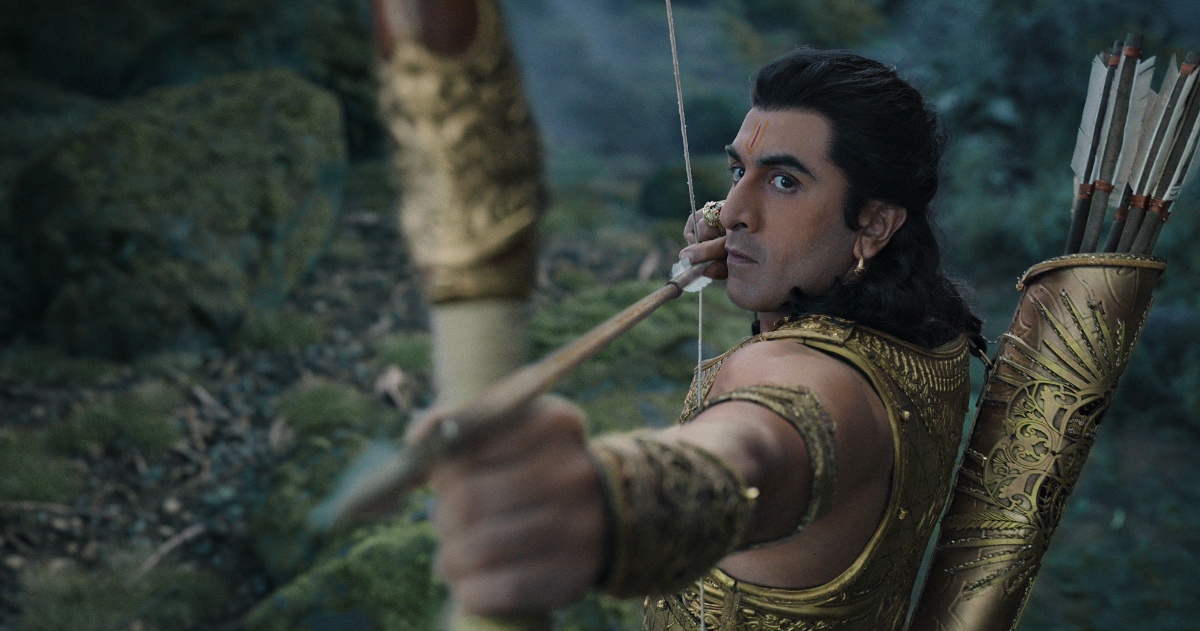
Ram (Ranbir Kapoor) takes aim
Photo: Sony Pictures
Defy the Gods
One nice-to-have going into Ramayana: Rise of a Legend would be a cheat sheet of who’s who. It’s something that would also help “outsiders” going into movies such as Forgotten Island and Ne Zha II, movies that draw on different cultures, lore, beliefs and mythology, rapidly introducing so many new, strange characters and situations that on one level might play as outlandish, but in a grounded way still convey truths. They are stories that resonate universally, but a little help to put it all in the proper context would benefit those unfamiliar with those worlds.
To that end, there’s the “flip side” to Ramayana, the story of Ravana.
During the movie’s first 39 minutes – all before the title card is even displayed – Ravana’s back story is brought to life.
Ravana (Yash) seeks to avenge his clan, a people living in the darkness as slaves. He seeks to challenge Vishnu for complete liberation as he also stakes claim to ruling the three realms (Heaven, Earth, Hell) for all eternity. He’s a wild, powerful man who’s shown racing through deserts, frozen tundra and oceans; he battles snakes and wolves with steely nerve. He’s tough.
At one point, Ravana holds such an intense meditation session, it threatens to destroy the entire world and requires the intervention of Brahma (the supreme spirit).
In comparison, the Force in Star Wars is rendered borderline tame.
Ravana promises no more bloodshed, no more tears as he declares, “I live like a king. They will, too. They will live in homes of gold.”
And so it is cast: a confrontation between Ram and Ravana.
Wisdom of the Sages
The ultimate lesson here is how destiny, or fate, is the sum of an individual’s life choices.
Destiny cannot be avoided. But people have the power to change it.
Certainly, given the staying power of Ramayana throughout the ages, there is room for adaptation and interpretation, as with virtually any other work. Particularly one such as sprawling and all-encompassing as this one.
It’s not that Ramayana: Rise of a Legend is the perfect movie. But it is bold and it is ridiculously ambitious.
Amid scenes sporting photorealistic effects of flying elephants and an awesome fight in the forest of Janasthana, there are the unwavering fundamentals of classic storytelling.
Ram is a stoic – yet sympathetic – hero perpetually put in the classic spot between a rock and a hard place. He’s been ushered into a 14-year exile at his own mother’s request. He was not allowed to be at his father’s side when he died. The beautiful love of his life, Sita, has been stolen from him.
He finds himself – much like Odysseus – with no army and no allies, but in desperate need to confront an evil force.
We cannot avoid destiny.
But by dharma, the moral law (living with compassion and responsibility), and karma, the law of cause and effect (each action shaping an individual’s existence), Lord Ram is preparing to make things right.
That’s a large-scale story worth experiencing on the biggest screen possible.

When elephants fly
Image: Sony Pictures
• Originally published at MovieHabit.com.
Contact 
Write Matt
Visit the Speakers Corner
Subscribe to Mattopia Times
Support 
Help Matt live like a rock star. Support MATTAID.
It's a crazy world and it's only getting crazier. Support human rights.
Search 
The Mattsonian Archives house more than 1,800 pages and 1.6 million words. Start digging.